Friday, 9 May 2014

Fungi and the World Wide Web

Some months ago I was at a local trash and treasure market and couldn’t resist a bargain of a garbage bag full of wool. It was in long loosely tied skeins and rather an odd selection of colours but it was only $5.00 and I felt sure I could do something with it. I like nothing better than turning something considered as excess rubbish into something value added.

What I discovered though is that I love bringing order to things. I am persistent and patient no matter how many loose ends I find.

.
 My life’s work seems to be about fighting entropy, the encroaching weeds, the overwhelming disorder of laundry, groceries and refuse.


So it was quite a surprise last weekend to find myself becoming passionate about one of the agents of entropy. I took part in a field survey of fungi in the Apollo Bay area with a passionate group of amateur naturalists as well as extremely knowledgeable professional expert guides including Alison Pouliot
We got to eat Lawyers Wig mushrooms (Coprinus comatus) for breakfast which were delicious. They were once a source of ink and so I made some ink from them by leaving them in a strainer to leak their inky juice and then made this painting of them.

I love to discover how much more I don’t know and believe me I haven’t even scratched the surface. It’s not surprising because in Australia there are literally thousands and thousands of unnamed and unclassified life forms. We just don’t have enough resources to do the work and government funding for scientific research is a very slim wallet.
 
A tiny little Ruby Bonnet (Mycena viscidocruenta)

When Britain set out to conquer the world and expand the empire she sent scientists to collect specimens from all the lands she invaded, just like humans have done with space travel ever since. It seems we can keep expanding our horizons, and the search for a Goldilocks planet is part of that endless quest to expand empire or to find a replacement for our own for when we have trashed this one. But there is just so much here to explore and to know.
Possibly Aminitis

Some of our greatest advances in medicine have come from fungi and moulds. Penicillin, cyclosporine (used in transplants) and where would we be without yeast for bread and beer and moulds for cheese?What we don’t know about the world of fungi is much greater than what we do know. Much of our knowledge of the plant world came from much earlier botanists and biologists who made their discoveries with the most rudimentary scientific equipment.Modern technology is making it more possible to see up close that which was only theoretical or blurrily similar to another. And yet we have never been more separated from real life up close than we are at this time in history. 

Children don’t wander around picking flowers and tugging at weeds, nor climb trees and share a limb with other wildlife. They dig in sanitised little plastic clamshells where their experience of digging to China is limited to the edges of Trueville. Their vegetables come in plastic packets so they never have the morbid thrill of finding a caterpillar sampling their peas in the pod first. They don’t poke and prod the earth to find potatoes and carrots for dinner or slip their hand under a warm hen to find a fresh egg. Everything in the most networked time in history is at the same time disconnected from its natural interconnectedness in the web of life.Fungi are the agents of entropy but are paradoxically agents for new life and new beginnings. They break down the carbon of trees and dead grass and leaves, animal excrement to make it available for new life. They work in partnership with other life forms, balancing populations, slurping up toxins, acting as a go between for neighbouring life forms, and also signal, to those who are attentive, changes in the state of the planet. Their mycelium are an endless trail of tiny white fibres hidden out of sight and act as electrical and nutritional networks for the plant world-the literal world wide web.


When we are always looking into the distance for the next new thing, the next thing to fill our insatiable desire for novelty, we fail to notice the wonder and novelty at our feet. We are constantly encouraged to embrace progress and technology and to keep marching forward leaving the past behind. The past contains old knowledge and old skills and in an interconnected world we must not forget that everything is connected through time and space. The beginnings of our universe are visible every night for us to see. Lichens and fungi originally converted the star material into a habitable place for us to live and still continue to convert our detritus. 
 There is an elegant classification system for all these life forms thanks to the early science of botanists and biologists. Seeing this structure briefly unfolded last weekend was a magical experience a bit like first learning to read. Each little structural element from gills (or none) to stipe(stem) and spore shape and colour has a hash tag just like Instagram. The hash tags need to be collected and compiled from all around Australia so that we have an inventory of just what is here. Fungi Map is working with professionals and citizen scientists to accumulate this knowledge. After all we may have the cure for cancer under our noses or new drugs to combat medically resistant viruses.


Meanwhile I have been exploring hash tags on my new Instagram (Cranky Ceramics) and hammering them for all they are worth.

Saturday, 26 April 2014

From the Sea to Harvard

maggie and milly and molly and may
             

maggie and milly and molly and may
went down to the beach(to play one day)

and maggie discovered a shell that sang
so sweetly she couldn't remember her troubles,and

milly befriended a stranded star
whose rays five languid fingers were;

and molly was chased by a horrible thing
which raced sideways while blowing bubbles:and

may came home with a smooth round stone
as small as a world and as large as alone.

For whatever we lose(like a you or a me)

it's always ourselves we find in the sea


It's well known that the Aussie culture is based around sun and sand. We live on an island, gigantic as it is but isolated from the rest of the world. We spend much of our time standing on our shores looking outward for signs of life. It has some bearing on our way of thinking. Sadly in recent years as we have become more self satisfied we gaze outward with fixed stares looking for those who might  come and steal our luck from us and cruelly turn away those who have no other refuge.

I have heard simple analysis of American politics that describes the land locked states as Republican and hell bent on preserving the American way of life and the coastal outward looking states as Democratic, more forward thinking and malleable of thought.

Whatever the final analysis, the magnetic draw to the liminality of the shoreline always throws me into deep thought. I am lucky to have frequent access to a place which has me looking at my city from the other side of the bay. 
Distance is very good for the creative process and for problem solving. It diffuses anxiety and creates a telescopic world view . The fresh air is always welcome but the wider view of a tiny vulnerable city under a gigantic and moving sky full of smog, and sometimes tumultuous weather conditions engenders a fondness for the little city on the horizon.

And in the vastness between I always hope to glimpse a sign of life like a leaping pod of dolphins to assure me that the sea is ok. I go to the water’s edge to read the signs like some shaman reading chicken entrails. In the case of our little coast line this liminal corridor is only 4-10 metres wide depending on the tides. It is bordered by a thin line of scrubby vegetation and some seasonal marshy wetlands. A strange scrap of space to become so attached to but without fail it draws me in every time.

The human eye is magnetically attracted to signs of other human life. On a beach of pebbles and crushed shells tumbled with seaweed a man made straight edge immediately stands out as alien. Fragments of ceramics from a time in the misty distance wash up, waiting to be collected and their stories to be divined.  


.  Broken glass is softened and blurred to romantic fragments . These are the treasures I don’t mind finding. They have possibility for a new life, made new and interesting by the sea and full of history. Old bones are exciting to find and wonder about.

 I really must brush up on my anatomy because I could be romanticising about an ancient whale or dolphin death, when in fact I should be calling police to analyse criminal evidence! So many stories write themselves for the briefest time. 

Seasonal changes can be read in the detritus that washes ashore. The empty Port Jackson shark eggs wash up around April. Strange sculptural spirals that harden irreversibly like dried kelp and when first held conjure up torturous images of birth until you understand the marvel of the original soft spiral. I picked one up some months ago thinking it was out of season and quite heavy. It gave a wobble in my hand and I realised it still held a live youngster that I could rescue by returning it to the water.
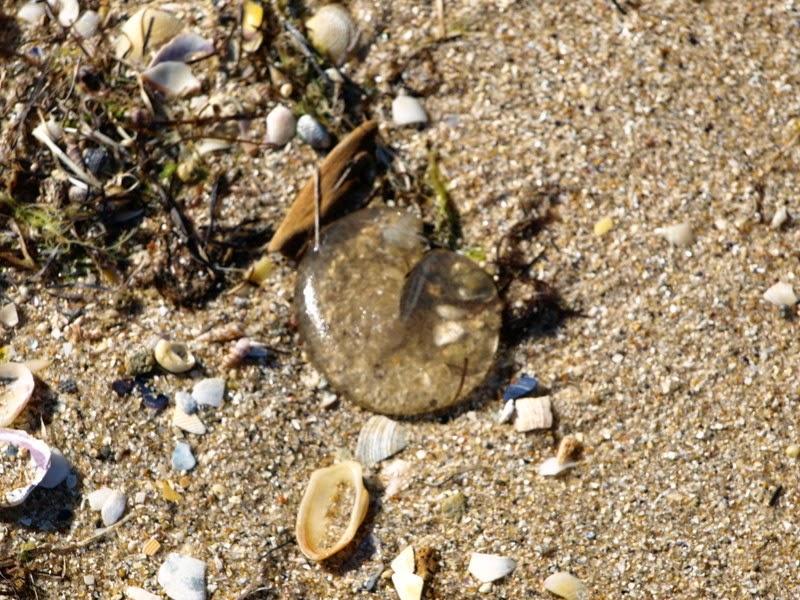
The moon snails come out around full moon to lay their giant jelly sausage  egg sacs on the beach to then be washed out with the next tide a mystery that baffled me all my childhood.


 The sea grasses used to be habitat for millions of sea urchins but dredging of the shoreline by commercial fishermen has removed most of the sea grass and the remaining urchins are quickly demolishing what remains of the grass. That beautiful crystal clear water we are so attracted to is a dying coastline. Sand and more sand with nothing to give shelter to small fish and crustaceans which in turn become food for bigger sealife.
One of my sea inspired tea strainers amidst the remaining fragments of sea grass and dead urchin shells.

The pelicans which were so numerous several years ago have mostly moved on to better feeding grounds and only 5 or 6 regularly scavenge this part of the coast. Seagulls are better fed up in the town and around the pier so are not in obvious hordes. Migratory birds arrive in scanty little groups of fewer than a dozen and I know I am looking at remnants of the natural history of the area which saddens and frightens me.
My mussel spoons. Photo credit Screaming Pixels


I love this liminal edge. It is where I wait for the sea to reveal itself to me. Unlike my partner who loves to sail and my son who is an underwater photographer I have feet of clay and am clearly a landlubber. The sea’s influence makes it way into much of my work as a sort of alter ego of my city work and garden inspired work. As I sit here typing, one of my sea inspired pieces is making its way across the world to Harvard University in Boston Massachussets for an exhibition called Object Spoon (organised by Vipoo Srivilasa) at Ceramic Top 40 in the new ceramics department to be shown 17 May to 27 May before heading back to Canberra for the Ceramics Trienniale.


Friday, 4 April 2014

Drawing No Conclusions


Recently I sold one of my watercolours at the Warranwood Art Show. I had a ceramic piece in the exhibition as well but Avis Gardner had a much more intriguing little treasure and deservedly scooped the ceramic award.
I love drawing and painting and years ago went through a crisis of confidence when I decided no one was buying 2d art so I stopped doing it. I felt that ceramics were more useful and functional and of course there would be a market for them. There is somewhere.

But I miss drawing and painting and it is a heck of a lot easier to store. I received a book on egg tempera many decades ago and fell in love with the images but felt the discipline of it was too daunting for a flibbertigibbet like me. Recently I came across a beautiful blog http://altoonsultan.blogspot.com.au/  by an egg tempera painter who also loves his garden and the food he can produce from it. I still felt overwhelmed reading through the instructions on egg tempera but there was one brief mention about milk tempera.

 I didn’t wait to find details but raced off to play in the studio and experiment.

 I think what appeals to me about it was that there was nothing to lose. I always feel a greater sense of achievement in producing something from nothing by just adding effort. Like the production of this grass basket from a grass that grows at my back door and delightfully sheds shafts with seed heads in autumn.

  A tablespoon or two full of milk and a sprinkle of 3 different food dyes will last for hours and every layer is exciting to develop. So this week I have had fun and feel inspired to keep going and experimenting.

The first experiment was just on good quality recycled printer paper and was just to see if it was possible to do. The paper warped and bubbled but a lovely sheen built up very quickly. The milk dries quickly between layers and subsequent layers can be built up without disturbing the underlying layers too much.


 Milk has fat in it which combines with the pigment to form a suspension. It also has casein in it which is an early ingredient in plastics. We have all seen milk drips spilt on tabletops dry to a sheen. What you end up with is a sort of primitive acrylic watercolour surface.

 With egg tempera it is important to have a stable surface on which to paint so wood panels have traditionally been used and gessoed with a toothy surface for the paint  to hold onto. Gesso is a mixture of whiting and a binder. Traditionally rabbit glue was used but that all started sounded complicated until I read that you could use gelatin as the binder. Gelatine, milk, whiting, pigments (especially earth) were all within my spheres of knowledge and interest. I haven’t got to the stage of gesso but that is on the agenda. I have made one experiment with clay and milk and will be on the lookout for different coloured soils to use as pigments from now on.


I have also done a preliminary test on some bisqued work to see if it has a similar effect to terra sigillata, something that I have done for some time now with my work. Terra sigillata is an application of the finest particles of clay which are applied in several thin layers. The tiny particles fill in the minute pits on the clay surface and develop a refractive sheen. I will try this on an unfired piece(greenware) and see if it is effective.


I have been happy with just experimenting on thicker quality cartridge to prevent the warping problem but will progress to gesso on Masonite for a more formal painting when I understand more of the qualities of the paint.

There is a dreamy 60s picture book texture to the images.


And my paintings are tiny. I found some old A7 sample paper pads that I bought in an art shop a few years ago and since I no longer remember the price of the bundle they have lost their overwhelming preciousness which always daunts me in experimenting.