Sunday, 7 July 2013

A day trip to Mona


Yesterday my beloved and I jumped up early, while the stars were still up and the cheap skates were trying to play golf by torch light before the links were open, and headed off to Tasmania for the day to see the Museum of Old and New Art- MONA.


It’s been on our to do list for quite a while but finding a whole weekend and the money for such a splurge just kept escaping us. This was a brilliant solution. No car hire, no accommodation costs and a direct bus to the gallery and pick up in time for our return flight which also meant cheaper parking costs at Melbourne airport. While we have several friends and relatives in Tasmania, to squeeze in time at Mona and time with them would diminish both experiences.  
 
 
I love visiting Hobart in the middle of winter. It is a chance to experience the full on cold of a southern winter, see the snow capped mountains and return home to only slightly chill Melbourne. It was max 6C in Hobart yesterday.


We were amongst the first arrivals for the day so staff were full of enthusiasm and good cheer and we were advised to make the most of our status by visiting the sarcophagus of um ?(sorry!) in a separate darkened chamber. It was The Indiana Jones part of the tour where only two people at time can enter a very dark space with a walkway surrounded by black slightly odoriferous water. The concrete pathway was about 900mm wide in reality yet seemed distorted in all the blackness and it felt precariously narrow and then petered out to only stepping stones which were uneven heights (only 3) which strangely seemed even more precarious. The sarcophagus and a matching one were lying side by side in the dim light one digitally animated to show images of the mummy and xrays through the bindings to the underlying organs and bones. I guess if it were shown in the raw light of day apart from the deteriorating effect of light on it, the whole experience could be a bit ho hum. By slowing down your approach and turning off some senses while alighting others it did what Science Works does not do-focus attention.
 
 
The whole gallery is built in an enormous sandstone pit beside the Derwent River. A minimum of light is used throughout partly because there are extremely valuable Egyptian artefacts and partly for theatrical effect. The architecture is astounding and we could not help but think of what a great place it would be to play nerdy electronic war games, up and down the hefty beamed walkways and tunnels hewn out of solid rock. It would also make a great nerd film set.
The current exhibition is The Red Queen and refers to Alice Through the Looking Glass  who when confronted by the Red Queen is caught up in a discussion of adapting or keeping up. The art refers to adaption mostly through genetics and mutation and points of difference in humans. Mona is often referred to as the museum of Life and Death and  there is certainly a sense of dipping into death and corporeal experience in the darkness and under the ground which will stay with me for a while.


There was one very powerful piece where a granite labyrinth  adorned with binary numbers which at first seem like timeline numbers going back to primordial days leads to a central tiny space with a mirrored ceiling.  I have always loved the prayerful purpose of a labyrinth in which you quietly wander toward the centre to yourself and then turn around and return to community. It was hard not to draw analogies to Persephone and the underworld.
 
One other piece that moved me partly because I got it wrong was a giant Buddha made of reinforced aluminium. I was staring in awe at this gigantic shiny Buddha made out of reinforced cast aluminium and full of respect for the artist who I thought had transformed an army tank into this beautiful Buddha. Then I heard the conversation behind me as the attendant explained to somebody else the process of making the twin of the Buddha I was staring at, out of incense ash from temples. The piece I was looking at was simply the mould to shape the dust which was headless due to building constraints or something and it was slowly collapsing in on itself. The artist is Zhang Huan. Awesome is a much misused word but it was awesome in concept and execution.


I cannot show you any photos of the art work even though I was free to take them for my own use  but which does not include internet sites. Mona is a wonderful gift by David Walsh to the people of Tasmania. I didn’t love everything on display and some things filled me with horror or revulsion. The whole atmosphere of darkness and some areas of electronic noise and strobe lighting were very disconcerting and disorienting. One particular series of works the Vivian Girls by Henry Darger, I found very uncomfortable at a visceral level but the slightly waving images suspended in frames around which you had to walk in very poor light made me feel so vertiginous  that I had to hurry out.
 
 
My overall experience will stay with me for a long time but strangely there was no dizzy euphoric sensation which I realise for me hits me when I am confronted by colour. By having to negotiate a space in poor lighting when I am already hindered by poor night vision shut down some creative force in me. There was no room left to think which I think is a little like the way the brain exists only in survival mode when traumatised. I have lots to think about for a long time and I will treasure some of the works I saw. I will certainly be back to do it all again in another year or so as long as David Walsh doesn't go broke paying back his gambling tax.
 
Bye Mona.


Tuesday, 2 July 2013

Designing holes

There is a famous Australian film called The Castle in which the son of an extremely ordinary family develops a sense of achievement in the world of DIY by digging a hole . This is followed by another  bland statement a few days later that he dug another hole. The droll nature of the statement has become a bit of an icon in our family, at least, since DIY has been quite a past time.  Digging a hole is actually quite hard work and digging a deep hole is extremely strenuous but when it is finished it doesn't jump out as a significant achievement.
So it is with ceramics. Essentially the potter is capturing a hole that didn't exist before. And a hole can make such a difference to the outer skin that holds it.
We seem to have an innate sense of proportion and pre determined calculation of mass that should accompany certain proportions so that when we come upon this magical combination our minds  then  immediately click other programs into action to assess surface, colour and feel. If we are drawn first to the visual colour, we might forgo mass or feel, because in our minds it has already become a decorative item and if our calculations don't add up about weight for volume we can overlook that. These intuitions probably go back to our survival skills of picking the juiciest fruit or heaviest coconut, that would repay the energy expended in climbing for it.

It is with all these seemingly intuitive judgments that the experienced ceramicist develops a form.

Is that hole going to contain just air for the rest of its existence, hot beverages, fat ice blocks, a chunky stew or a special little treat? Do spoons or chopsticks have to wrestle with its interior? Are the contents going to extend beyond the top of the opening and therefore change the centre of gravity.

So many times when selling things at markets we ceramicists are bemused by the question "What would you use it for?" I don't know if this is because buyers want to know if they are committing a sacrilege to feed the beloved kitten milk from it or whether they think there is some secret code in the ceramics world tied to notions of value that ascertain whether a piece is going into the "good" room. Heavens to Betsy if you "use" the Wedgewood!
 
 
Sometimes I can't believe that people have so little imagination, or are so bound with convention.  The idea of a container that can be used for one tim tam and also for wasabi  or dukkah at  a dinner table is a revealation to them. Our job is not just to provide the object but also the vision to go with it. I can't believe our audience want to be dictated to.

When I make vessels I use a printed guide of the Golden Mean. It was used by artists of the classical eras and is sometimes attributed to Euclid.
1:618..... it occurs in nature through the Fibonacci spiral and it is what dictates our seemingly innate sense of proportion.

I don't use it religiously but when I have developed something new and want to make a decision about its proportion, I might just put it up against the guide. When I have made something I don't feel comfortable about it usually doesn't fulfil the proportions of the golden ratio and sometimes the addition of a higher foot ring might make all the difference or  the addition of a darker colour in one part might give a sense of grounding and balance.

I haven't got it all worked out. I struggle with every little hole I make. I fight a mind that constantly seeks novelty over pursuit of perfect form. If my work becomes too perfect I whack it or bend it or draw on it left handed. I want my pieces to resemble humanity and none of us conforms to the golden mean entirely. I fight the machine made look that comes with constant practice. I know that if I spend a week in the studio at my wheel my pieces dance off the wheel as perfect little replicas but my urge is to fight that because the gesture and nuance is lost. Regular and matching is what the buyer wants but I have always been a rebel and I am my own worst enemy. We want to choose the puppy from the litter that we feel most connected to and a bowl or beaker that fits our hand and heart.

 So bad luck if you want any of my pieces fitted neatly on your shelf and perfectly lined up. It's not going to happen and if that is what you want you are best to go to Ikea.

                                           POST SCRIPT
A beautiful video on Fibonacci sent to me by Mirta
http://www.youtube.com/watch?v=P0tLbl5LrJ8&feature=youtu.be

Tuesday, 25 June 2013

One of My Best creations

It is 2 years since I moved into the house that I now live in. My husband and I have renovated 4 other houses over many years and seen nearly all the mistakes that can be made, and the money that can be drained into making dreams based on chasing desires dictated by clever marketing.
This house is different. It was a house planned for an unpredictable future while at the same time trying to make the most of everything that was available to it. We combined all of the aspects of our lives together that we have most cherished, and incorporated them with scientific data about future climate as best we could envisage, to make something that is uniquely us. We trimmed and compromised our wishes, and while the building work went on with all its hassles I dreamed of the places I would sit and wonder in the garden.

It was at worst a terrifying experience, after the initial euphoria of committing to it and there were many dark moments when our control of the project was in the hands of a Dr Jekyll builder, who at times broke our hearts with his callous and shoddy interpretations of our design.
When the builders left 2 years ago our house was sitting in this.


Our excitement about moving into our new home and starting a new chapter in our lives was being shattered on a daily basis and the builder's parting gesture of leaving us with 2 tonnes of rubble and a skip full of building junk was nearly the last straw. We had lived in a dodgy brothers rental that we had had to sandbag for 2 years, put our beloved dog
 
 into an adoption program and then had to move one more time for 8 weeks into my old childhood home which had been empty and decaying for a year. To add insult to injury when we finally moved, the heating and stove were not connected for another 3 weeks in the middle of winter. Our bodies sucked up all the stress and continued to feed it back to us for the next few months.
 
The garden saved me.
 
Having a project that was big and unbelievably physical and so exposed to passing public, was a catharsis. After lugging and digging and bending for 8 hours a day for 3 solid weeks of freezing weather in order to create the skeleton framework for the garden, I had no choice but to sleep at night.
 
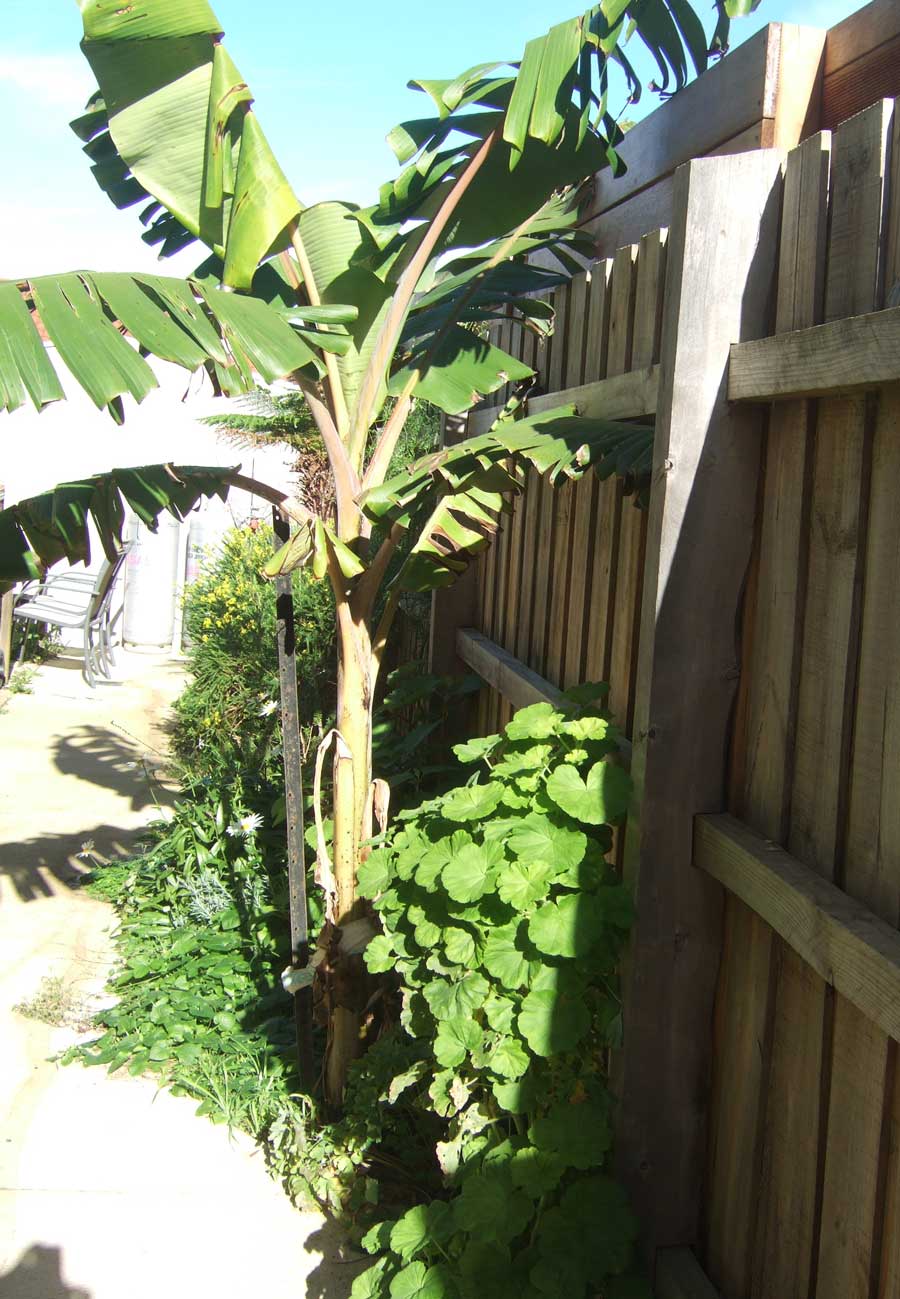
I met passersby who were cynical about our strange new building. I met xenophobes who couldn't bear to see their neighbourhood changing. I met endless dogwalkers and encouraging gardeners, and I gradually insinuated myself into my new space. As much as possible of the building rubbish and packaging has been built into shaping garden edges and mounds and I am constantly finding new ways to rehabilitate another part of the garden. The previous garden was loved and owned by one owner and I promised her when we bought the block that I would try to preserve as much as possible or to plant another garden of beauty. Many of the first plants came from her plants which I rescued before building began. We have kept the 60 year old fig tree, a flowering gum, a callistemon plus a Tangelo and Valencia orange tree as well as smaller old fashioned shrubs.  Other plants came from my childhood home along with hundreds of tiny tubes of plantlets which looked painfully insignificant to begin with.
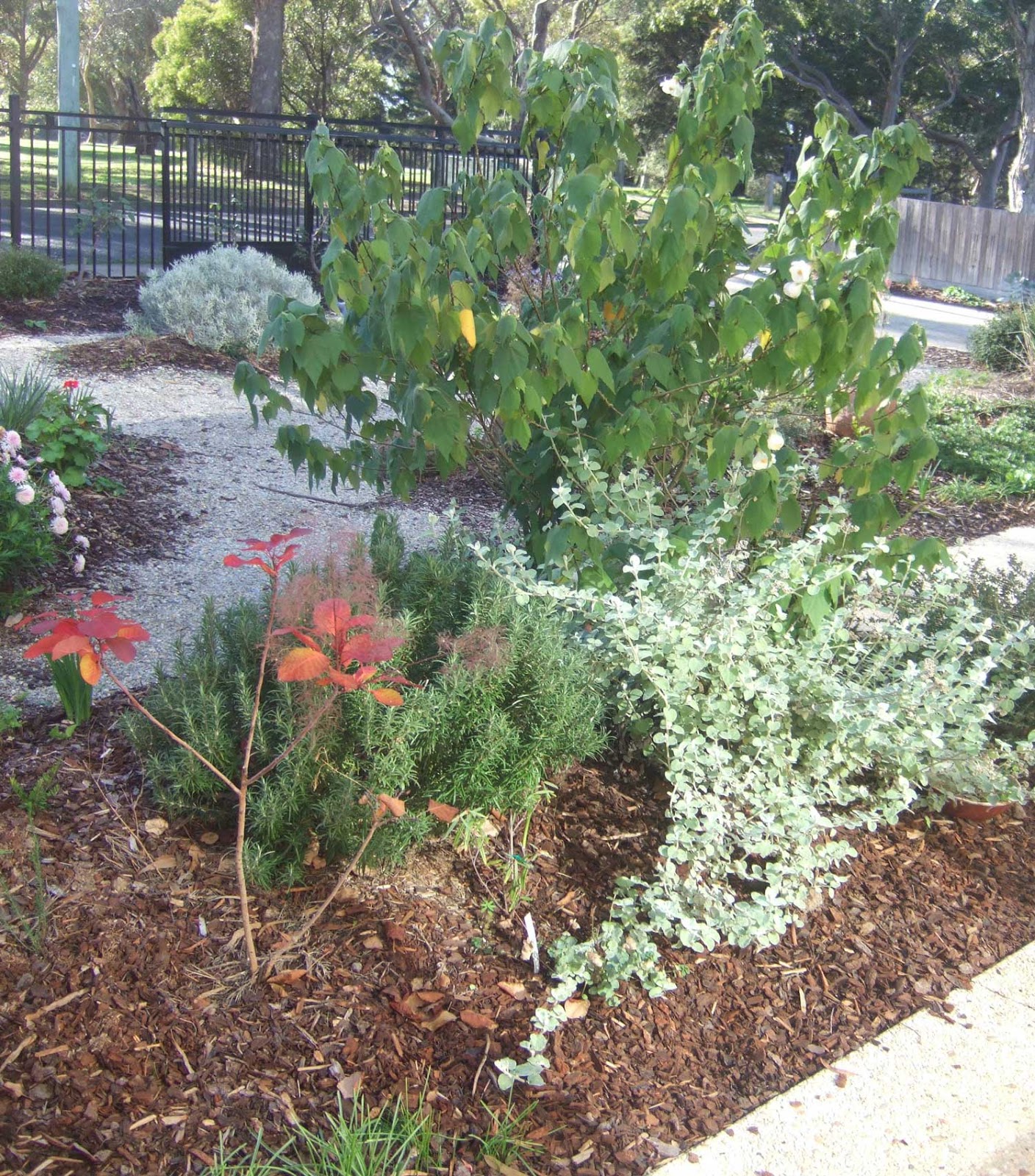
2 years on I have lived off food from 52 different plants in my garden. I have rehabilitated a filthy abused building site into a sanctuary for birds, frogs and small critters, and I always have something in my garden to offer to visitors which is something I really love to share.


I love listening to passing children on their way to school or the park, wishing they could live at my place and explore it. It freaked me out at one time to have people stop and photograph the house and garden (even at midnight), but now I get a bit of a giggle to see aspects of our house copied around the place and I can happily suck up the compliments from  passing admirers. 
 
The best part of creating a garden is that it is an evolving and interactive work of art. You can predict sizes of plants and recognise the conditions which will help them to thrive but they will change and respond to one another and the climate in ways that we humans are too fallible to predict. If I have estimated correctly many of these plants will continue to contribute benefits to the heating and cooling of our home in years to come. I have played computer games like Sim City and other simulated organic developmental programs but no digital experience is a substitute for this real life. 
 
A garden responds to love, but also offers surprises and delights when you least expect them. It is the ultimate science laboratory, pantry, teacher and healer. I have relearned hope with grace from nature. I have more confidence about who I am because I have made a big thing that I know is going to become more beautiful with age and with any luck might last as long as the garden before it.
An encouraging neighbour at this time last year quoted me an old adage about gardens. "In the first year they sleep. In the second year they creep and in the third year they leap."
She was right about these first two years so next year might be astounding. Happy anniversary House!